Post 10: Don’t Just Trust Election Results. Verify Them.
A 2024 audit revealed conflicting voter totals in one Florida county — a 24,315-voter gap, 1 in 10 records unaccounted for, and 35 of 61 precincts reporting more votes than voters.


In 2024, many Americans were told to accept the results and move on — even as simple math questions lingered. A functioning democracy does not run on blind trust. It runs on numbers that can be reconciled.
To listen to the article, click the video below. To read the article keep scrolling down for the whole story.
When people expressed disbelief that Donald Trump won all swing states in 2024, we were told to trust and certify the results — unless we could verify that they were wrong. The work needs to start now to ensure record-keeping meets legal standards — so forensic audits can occur in real time.
But it’s not just the swing states that have lingering questions. In Florida, official voter registration records published by the state don’t match the numbers in their own internal systems. Those records were part of the state-run system used to certify state elections. They were also used to certify federal office holders. It determines 28 U.S. House seats and sometimes a Senate seat. The most recent Senator elected was Rick Scott. In 2026, it will be the basis for who ultimately fills Marco Rubio’s vacant seat.
And it’s not just voter records. 23 batches of votes in one Florida county were unaccounted for in the final certified vote counts. If a bank told you that 23 of your deposits hadn’t been counted, would you simply sit back and do nothing?
Why accept sloppy paperwork and lack of accountability from our election systems when we would never accept that from our bank accounts? Especially when the states are legally required to keep paperwork that would allow us to verify the results.
The Numbers Don’t Lie, or Do They?
Two official totals.
Same day.
Same County.
Same statewide system.
That’s what happened in 2024. To detect whether this was a pattern, we attempted to reconcile again in 2025.
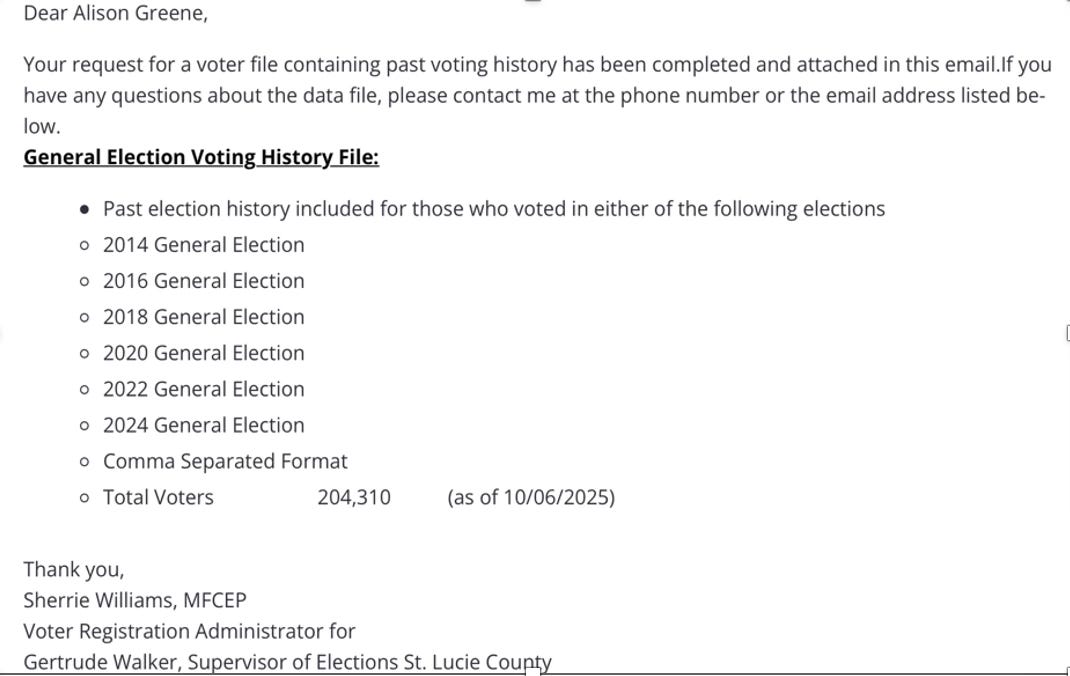
On October 6, 2025 — the deadline to register for a local special election — a public records request pulled directly from Florida’s official voter registration database showed 204,310 active registered voters in St. Lucie County.
On that very same day, the county’s publicly reported total — drawn from that same statewide system — showed 233,739 active registered voters.
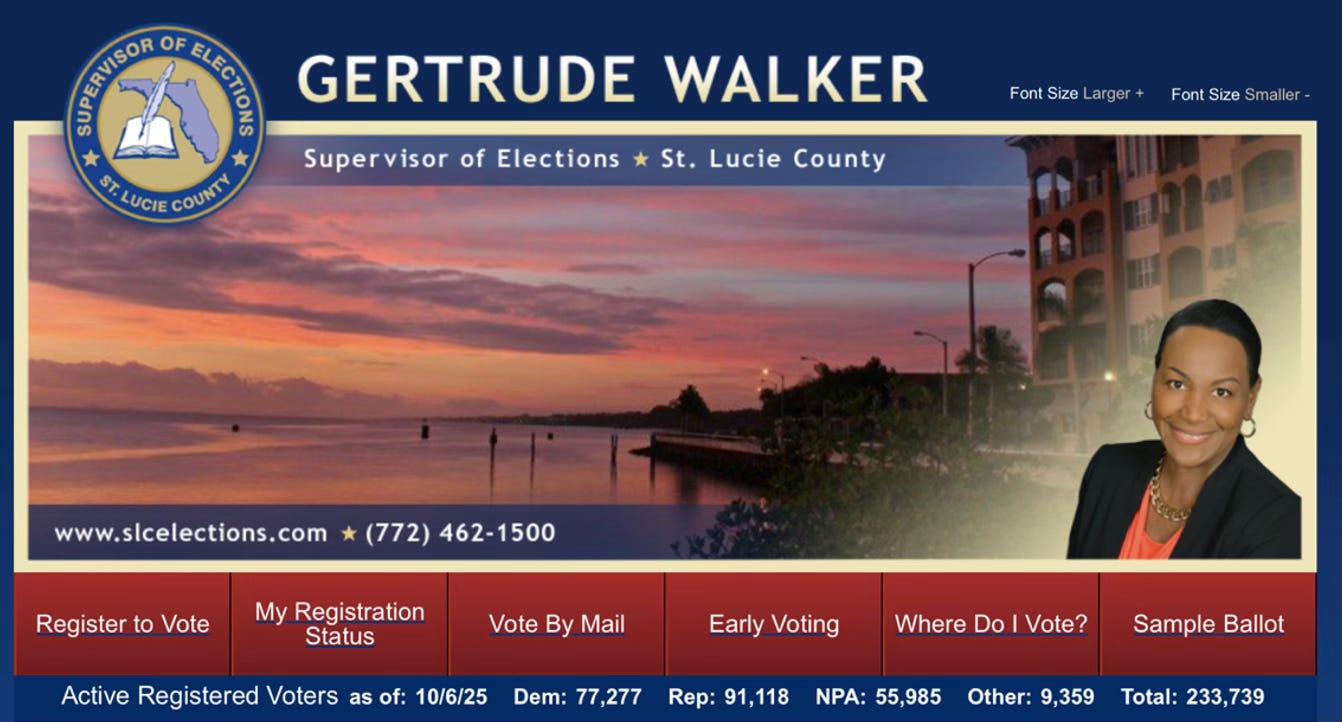
The difference in 2025: 29,429 voters.
The difference in 2024: 24,315 voters.
Two Elections in a Row. Neither Could Be Reconciled.
Florida is legally required to maintain one centralized voter registration system. One official voter roll. Counties operate within that statewide system. It is supposed to track eligibility, record participation, and preserve voter history for reconciliation and audit.
A centralized system is expected to produce consistent totals.
If the numbers differ, there should be documentation explaining why.
So how does one official system produce two different active voter totals on the same day?
Which number reflects the actual pool of eligible voters?
And why does it appear that nearly 30,000 voters are missing from one version of the official roll?
Year after Year the Numbers Don’t Line Up
As discussed, the 2025 discrepancy did not appear out of nowhere.
In 2024, during a yearlong review of election data in St. Lucie County, we first encountered reconciliation problems inside the voter registration system itself.
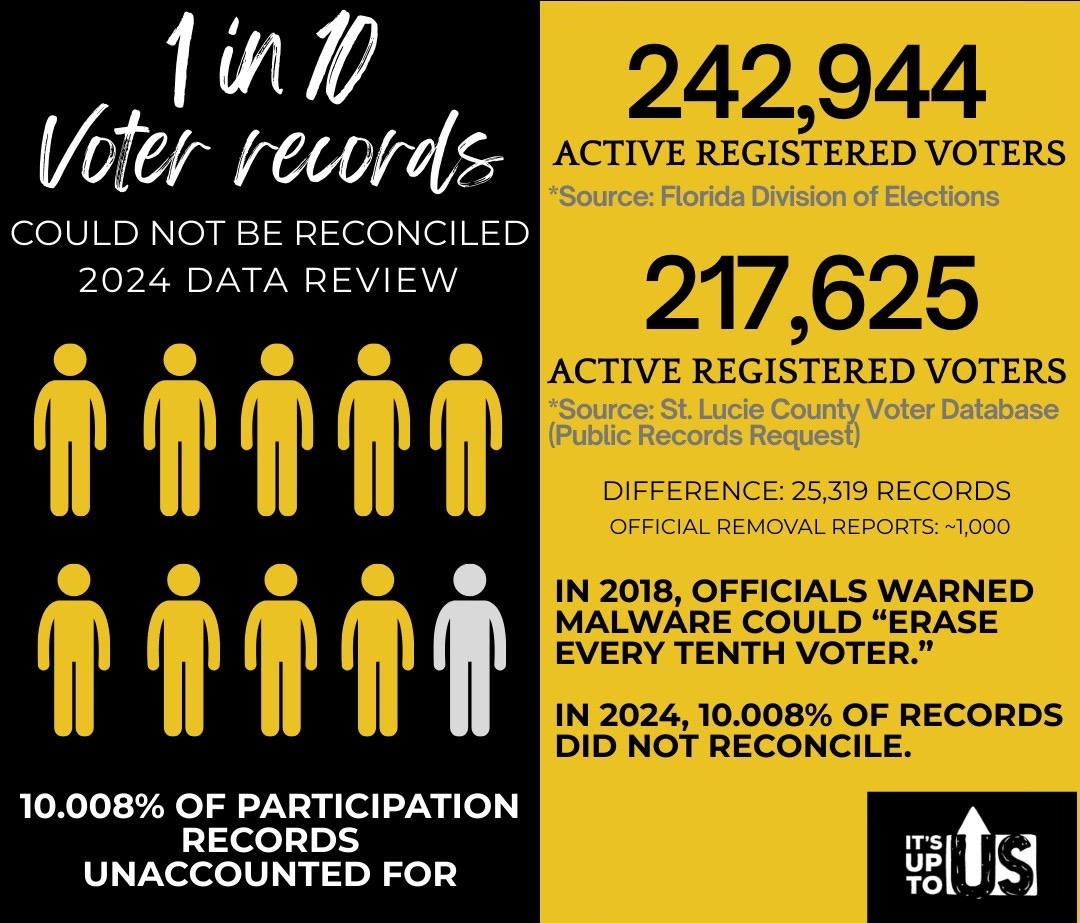
After submitting public records requests for voter participation data, we found that 10.008% of voter participation records were unaccounted for. The data from the system did not match the totals used to certify the election.
This close to the election the records should have been preserved. Yet approximately one in ten could not be found.
More than 25,000 records did not align with the numbers used to declare winners and losers.
This wasn’t a clerical typo. We attempted to reconcile the totals against official removal reports published by the Florida Division of Elections. Those reports accounted for roughly 1,000 removals — not 25,000.
The gap remained.
And that wasn’t the only problem.
More Votes Than Voters
When we compared precinct-level participation records from the voter database with the officially certified results, 35 of 61 precincts showed more ballots counted in the presidential race than voters recorded as having participated.
Take Precinct 50.
The state-certified results showed 7,863 votes cast in the Presidential race.
But the voter history database — where each voter’s participation record is preserved — showed only 7,801 voters participating.
Sixty-two more votes than voters.
Two official records.
Same precinct.
Different totals.
Sixty-two votes by itself may not swing an election. That isn’t the point.
The point is simpler than that.
When you add up the numbers, they either match — or they don’t.
Precinct 50 was not alone. Thirty-five precincts showed similar mismatches. When discrepancies repeat across more than half a county, the issue isn’t a rounding error. It’s a pattern.
If your bank statement showed one incorrect charge, you’d call the bank. If half the transactions didn’t match, you wouldn’t say, “It’s probably fine.”
You’d demand the problem be resolved.
Elections are not supposed to run on “probably fine.”
States are entrusted with administering elections because the Constitution guarantees the people the right to vote. That right only means something if the results can be checked.
Not trusted.
Checked.
“Trust but verify” only works when verification is possible.
When participation records don’t match certified totals, verification becomes impossible.
And when verification becomes impossible, we are left with trust alone.
That is not how elections are supposed to work.
The Missing Batches
The reconciliation problems did not stop with voter records.
Ballots in St. Lucie County are counted and reported in sequentially numbered batches.
Absentee ballot batches appeared sequential and complete.
But early voting and Election Day batches did not.
In the early voting reports, numbering jumped from EV-0230 to EV-0243, with additional gaps later in the sequence. Election Day batches also contained missing entries.
In total, 23 sequential batch numbers were absent from the published reports.
Twenty-three missing entries may not sound dramatic at first glance. But sequential numbering exists for one purpose: traceability.
Based solely on the published documentation, there is no way to determine how many ballots were associated with those 23 missing sequence numbers.
The totals used for certification included only the batches that appeared in the record. Without documentation for the absent entries, auditors cannot determine whether those batches were voided, merged, reclassified, or otherwise accounted for elsewhere.
This is not an accusation that ballots were discarded.
It is a statement about what cannot be verified. An auditable system removes that uncertainty. That’s why laws require appropriate record-keeping.
A bank ledger works the same way. If an auditor told a Chief Financial Officer, “Twenty-three deposit entries are missing from the sequence,” the first question would be obvious: “How much money is unaccounted for?”
If the answer were, “We don’t know — the deposit records aren’t available,” no competent financial officer would sign off on that ledger.
The issue is not whether each deposit was $10 or $10,000.
The issue is that without those entries, no one can calculate the total exposure.
Election ledgers should be no different.
Corporations reconcile dollars because shareholders demand accountability. Elections must reconcile votes because citizens are entitled to it. And unlike money, a lawful vote cannot be reissued once it is miscounted.
Certification requires completeness.
Why Simply Counting Ballots Is Not Enough
Some readers may respond at this point: “Yes! Just hand count the ballots.”
But hand counts confirm how many physical ballots are in a stack. They do not answer a different question — whether every ballot in that stack came from a lawfully eligible voter whose participation is properly recorded in the system.
In Post 7 of this series, we examined what happens when ineligible or fabricated voter records are introduced into the rolls. We highlighted a documented case in Florida in which more than 130 fraudulent voter registrations were created by foreign nationals. Those individuals were caught because they redirected election mail to a small number of controlled mailboxes.
Had they not been caught, ballots issued to those fraudulent registrations could have been completed and returned like any other ballot. Once separated from identifying information, those ballots would have been indistinguishable from ballots cast by legitimate voters.
That is the structural issue.
Ballots are secret by design. They carry no identifier linking them back to a specific voter. That protects privacy. But it also means that reconciliation between the voter roll and the ballot count is the only way to verify that each counted ballot corresponds to a lawful participant.
If participation records and ballot totals do not align, counting the same stack of ballots again does not resolve the discrepancy. It simply recounts what is already there — without confirming whether every ballot was tied to an eligible, properly recorded voter.
Verification requires both sides of the ledger: the ballots and the voter records.
The 1-in-10 Warning
Years before these discrepancies were identified, U.S. intelligence agencies concluded that Russian operatives had successfully breached election systems in multiple states, including Florida.
According to reporting later detailed by Bob Woodward, intelligence officials briefed President Trump in 2018 that malware had been placed inside voter registration systems in at least two Florida counties — including St. Lucie County.
Officials reportedly said there was no evidence the malware had been activated.
But they described its capability precisely.
It could “erase every tenth voter.”
Not ballot.
Not vote.
Voter.
In 2024, 10.008% of voter participation records in St. Lucie County could not be reconciled through public records analysis — approximately one in every ten.
The similarity does not prove activation of malware.
But it does underscore why reconciliation matters.
Auditability must confirm both: no unlawful ballots were included and that no lawful ballots were excluded from the official vote totals.
If voter participation records are incomplete, altered, or unreconciled, there is no way to confirm that every eligible voter who cast a ballot is reflected in the final count.
And if batch documentation is incomplete, there is no way to confirm that every lawfully cast ballot made it into the certified totals.
That does not mean ballots were discarded.
It means the records do not allow us to prove they were not.
If voter records were ever improperly removed after ballots were cast, official totals no longer reflect every lawful participant — and the certified outcome would rest on incomplete records.
Because ballots are secret, so once separated from identifying information, there is no way to reconstruct whose ballot was included and whose was not.
That is why reconciliation between participation records and ballot totals is not a technicality. It is the safeguard. Checks and balances.
Verification requires more than counting what is present. It requires demonstrating that nothing is missing.
When a system was previously identified as capable of erasing one in every ten voter records — and the 2024 results show 10.008% of voter records unaccounted for — the similarity underscores why transparency is not optional.
It is necessary.
Subtraction and Addition
In sworn testimony, Special Counsel Jack Smith described evidence that led to the indictment of Donald Trump for conspiracy to obstruct the 2020 election and to violate the voting rights of American citizens.
In explaining the charges, Smith referenced efforts to “get rid of votes” and to “find votes.” Those were part of the factual basis presented to a grand jury.
Getting rid of votes is subtraction.
Finding votes is addition.
Under federal law, both can dilute lawful ballots by altering totals.
Addition and subtraction are two sides of the same ledger.
In earlier posts in this series, we examined examples of duplicate participation and irregular voter records — instances where ballots were cast in more than one jurisdiction or where eligibility records raised questions. That is what “finding” votes can look like in a modern system: not stuffing paper into a box but manipulating entries inside databases. Modern election systems rely heavily on software, which makes transparency and auditability even more important.
The question here is not whether the specific conduct charged in 2020 occurred in St. Lucie County.
The question is this: If subtraction or addition were occurring inside a system, would the current records allow anyone to prove it?
If the answer is no, auditability is already compromised.
Normalization
In our Just Jack episode, we visited the closed-door testimony of Jack Smith where Representative Pramila Jayapal asked what happens if election interference occurs and those responsible are not held accountable.
The answer: “It becomes the new norm.”
And when asked what that would mean for democracy, Smith responded with one word: “Catastrophic.”
That exchange was about accountability. It also applies to verification.
When machine counts are treated as final without question.
When mismatches are treated as technicalities.
When missing documentation is brushed aside.
When the public is told to accept totals without being shown how they reconcile.
That becomes normal.
Across the country, millions of people question election outcomes. Suspicion thrives where verification is absent.
An auditable system removes guesswork. It replaces belief with evidence.
If reconciliation records are incomplete, the public is left without proof — proof that the outcome was accurate, or…proof that it was not.
Elections are not supposed to be matters of belief.
They are supposed to be matters of record.
The 2026 Standard
This is not about relitigating 2024.
It is about what comes next.
If we are going to entrust states with the authority to run elections, then those elections must be auditable — not in theory, not in press releases, but in the underlying data.
We are told to trust the system. Fine.
But trust without verification is not a safeguard. It is an assumption.
If the books do not balance, we do not move on.
We reconcile them.
And if reconciliation is not possible, then fixing that must become the work before the next election — not after it.
When the 2026 election results are announced, will we find ourselves in the same position as 2024? Having to trust because there is no way to verify? Because if we want to be able to accurately verify, we must start ensuring proper record-keeping to guarantee auditability now.
Actions to Come
We’re working with others such as SMART Elections and Election Truth Alliance (ETA). Leading up to 2026 don’t just wait to contribute to your favorite candidates, help support grassroots organizations like It’s Up to Us by becoming a paying member. We are continuing our investigations, developing technology tools, and preparing legal strategies.
But grassroots organizations cannot succeed on a shoestring budget. All these solutions cost money and we will be crowdsourcing — but in the meantime consider upgrading to a paid Substack subscription. That is currently our only source of funding — the last years investigation occurred with no financial support — and all ongoing actions that we can take before the midterms need the support of our community. It’s up to all of us.
 | A guest post by
|
If the elections are fair, Trump will be done.
Allison,thank you for this clear, precise explanation.
I knew that there was cheating going on the morning I heard trump had won on Nov. 6, 2024.
How can we verify that our own state elections were tampered with?
And, as citizens of our state, can we confirm the results of 2026 will be verifiable?
Is there a process that, we the citizens, can follow to assure that our voting system is truly verifiable going forward-starting now?